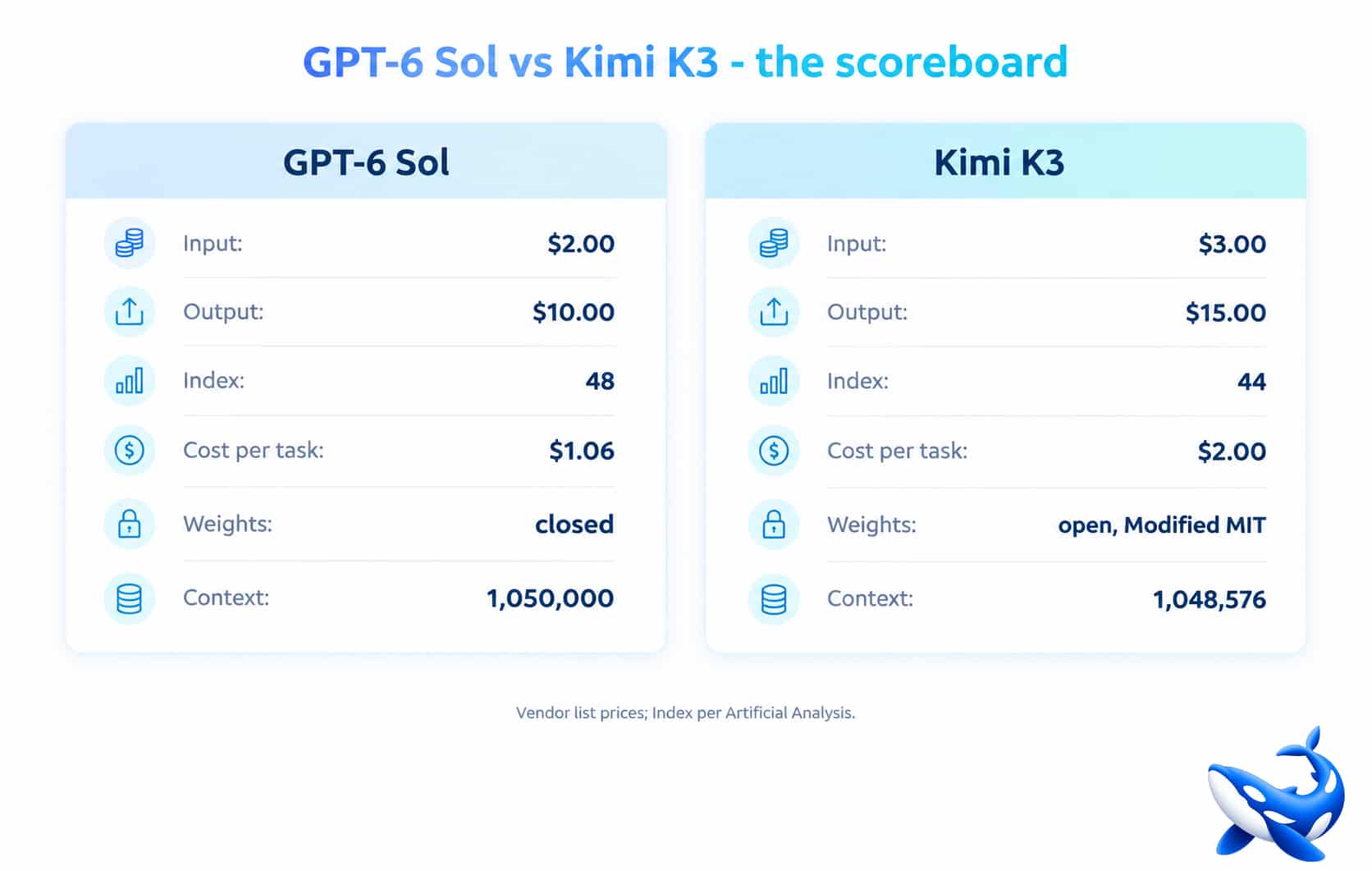
GPT-6 Astra and Kimi K3 are two large AI models aimed at demanding workloads such as software development, reasoning, research and AI agents. But how do they compare on performance, pricing and context window? This guide examines GPT-6 Astra vs Kimi K3 from a practical perspective, including API pricing, long-context capabilities, coding, reasoning, multimodal features and developer use cases.
“`GPT-6 Astra vs Kimi K3 Overview
“`The GPT-6 Astra vs Kimi K3 comparison is particularly interesting for developers and businesses looking for high-capability AI models. Both models are positioned for demanding tasks, but they approach the market differently.
Advanced General-Purpose AI
GPT-6 Astra is presented by OpenAI as its most capable model for complex end-to-end work, including reasoning, coding, computer use, research and document creation. Its published context window is approximately 1.05 million tokens, with up to 128,000 output tokens.
Long-Context Open Model
Kimi K3 is a 2.8-trillion-parameter model from Moonshot AI with a 1-million-token context window. It is designed for long-horizon coding, reasoning and knowledge work, and includes native multimodal capabilities for text, images and video.
GPT-6 Astra vs Kimi K3: Performance and Reasoning
“`Both models are designed for tasks that go beyond basic chatbot conversations. Reasoning, coding, tool use and long-running workflows are important parts of their positioning.
OpenAI describes GPT-6 Astra as a model for complex reasoning, coding, computer use, research and document creation. Its reasoning effort can be configured across several levels, including low, medium, high, xhigh and max.
Kimi K3 is positioned around long-horizon coding, knowledge work and reasoning. Moonshot AI also highlights tool use, autonomous technical workflows and complex engineering tasks as important capabilities.
Why Benchmarks Are Not Enough
Public benchmark scores can help developers understand general capabilities, but production performance depends on the specific application.
For example, a developer building an AI coding agent should evaluate repository understanding, debugging, tool selection, test execution and the ability to maintain context over multiple steps.
A research application may instead care more about long-document comprehension, citation workflows, information extraction and multi-step reasoning.
“`GPT-6 Astra vs Kimi K3 for Coding
“`Coding is one of the most important areas in this comparison. Both models are designed for advanced software-development workloads.
GPT-6 Astra for Developers
OpenAI lists coding among GPT-6 Astra’s intended uses. The model can be used for software development, debugging, code analysis and more complex engineering workflows.
Kimi K3 for Developers
Kimi K3 is explicitly positioned for long-horizon coding. Moonshot AI describes applications including kernel optimization, compiler development, scientific computing and other technically demanding workflows.
Kimi also makes K3 available through Kimi Code, including terminal and supported IDE workflows.
GPT-6 Astra vs Kimi K3 Context Window
“`Context length is one of the most interesting aspects of this comparison because both models operate around the one-million-token range.
| Context Feature | GPT-6 Astra | Kimi K3 |
|---|---|---|
| Published context window | 1,050,000 tokens | Up to 1,000,000 tokens |
| Maximum output | 128,000 tokens | Depends on API configuration |
| Long-document workflows | Supported | Supported |
| Long-horizon coding | Supported | Explicitly emphasized by Kimi |
GPT-6 Astra’s official model documentation lists a 1,050,000-token context window and 128,000 maximum output tokens. Kimi K3’s official documentation lists a 1-million-token context window.
What Does a 1 Million Token Context Mean?
A million-token context can allow an AI application to work with very large amounts of information in a single interaction. Potential applications include large codebases, technical documentation, research collections, logs and lengthy project histories.
However, context size should not be confused with guaranteed comprehension. Developers should test information retrieval and reasoning across long prompts before assuming that every piece of information will receive equal attention.
“`GPT-6 Astra vs Kimi K3 Pricing
“`Pricing is one area where the difference can be significant. The exact cost depends on the provider and API route being used, so developers should compare like-for-like pricing.
OpenAI API Pricing
Input tokens
Output tokens
Cached input is listed at $1 per million tokens, while cache writes are listed at $12.50 per million tokens.
Kimi API Pricing
Input tokens
Output tokens
The official Kimi API platform lists K3 at $3 per million input tokens and $15 per million output tokens, with separate cache pricing.
Based on the currently published first-party API prices, Kimi K3 has lower listed per-token API pricing than GPT-6 Astra. That does not automatically mean a lower total application cost because latency, output length, retries, infrastructure and task success rates also affect the economics of an AI application.
Kimi K3 vs GPT-6 Astra: Multimodal Capabilities
“`Kimi K3 is explicitly described by Moonshot AI as a native multimodal model capable of understanding text, images and video. This can be useful for applications involving screenshots, documents, visual research and video analysis.
GPT-6 Astra’s official model description emphasizes complex reasoning, coding, computer use, research and document creation. Developers should consult the current API documentation for the exact input modalities and tools supported by the endpoint they plan to use.
Potential Multimodal Developer Applications
- Screenshot analysis
- Document understanding
- Visual debugging
- Video analysis
- UI testing
- Computer-use agents
- Visual research workflows
GPT-6 Astra vs Kimi K3 API Access
“`Both models are available through API-based workflows. Kimi’s official platform currently lists K3 for developers and organizations, with pay-as-you-go usage and enterprise options.
Kimi K3 is also available through Kimi Code and can be used in supported development environments. Moonshot AI says model weights are available for developers who want to explore their own deployments, subject to the applicable license terms.
Developer API Features to Evaluate
- Streaming responses
- Structured output
- Tool calling
- Rate limits
- Context limits
- Latency
- SDK support
- Model availability
- Monitoring and usage controls
- Data handling policies
GPT-6 Astra vs Kimi K3 Comparison Table
“`| Feature | GPT-6 Astra | Kimi K3 |
|---|---|---|
| Provider | OpenAI | Moonshot AI |
| Context window | 1,050,000 tokens | 1,000,000 tokens |
| Maximum output | 128,000 tokens | Check current API limits |
| Input API price | $10 / 1M tokens | $3 / 1M tokens |
| Output API price | $50 / 1M tokens | $15 / 1M tokens |
| Coding | Supported | Strong focus |
| Reasoning | Advanced reasoning | Advanced reasoning |
| Long-horizon workflows | Supported | Explicitly emphasized |
| Native multimodal capability | Check endpoint documentation | Text, image and video |
| Open model weights | Not presented as an open-weight model | Weights available subject to license |
Published model specifications and pricing can change, so this table should be treated as a snapshot rather than a permanent specification sheet.
“`Best Use Cases for GPT-6 Astra and Kimi K3
“`Software Development
Generate code, debug applications, analyze repositories and assist with complex engineering workflows.
AI Agents
Build systems that combine reasoning, tools, APIs, databases and multi-step autonomous workflows.
Research
Analyze large quantities of information and create structured research outputs.
Long Documents
Process large technical documents, specifications, logs and other long-context information.
Multimodal Applications
Analyze text, images and video where supported by the selected model and API.
Knowledge Work
Automate research, documentation, analysis and other complex information workflows.
How to Benchmark GPT-6 Astra vs Kimi K3
“`If you are deciding between GPT-6 Astra and Kimi K3 for a production application, create a benchmark based on your actual workload.
1. Test Real Coding Tasks
Give both models representative programming problems from your technology stack. Measure compilation, test success, debugging accuracy and the amount of manual editing.
2. Test Long Context
Provide both models with large documentation sets or repositories and test whether they can correctly retrieve information from different sections of the context.
3. Measure Total Cost
Record input and output tokens, retries, latency and human-review time. The lowest token price does not necessarily produce the lowest cost per successful task.
4. Test Under Load
Production applications can generate thousands or millions of requests. Test rate limits, concurrency, failure recovery and latency before committing to an architecture.
5. Evaluate Long-Running Agents
If you are building an AI agent, test whether the model can maintain a coherent plan over multiple tool calls and recover from failed operations.
The Bottom Line
“`GPT-6 Astra and Kimi K3 are both positioned for advanced AI workloads, with approximately one million tokens of context and strong capabilities for coding, reasoning and knowledge work.
The current published API pricing shows a substantial difference: GPT-6 Astra is listed at $10 per million input tokens and $50 per million output tokens, while Kimi K3 is listed at $3 per million input tokens and $15 per million output tokens on Kimi’s API platform.
For developers, however, pricing is only one part of the decision. Coding quality, reasoning, latency, tool use, multimodal requirements, deployment flexibility and application-specific reliability should all be tested before selecting a model.
A controlled benchmark using your own codebase, documents and production-like requests is the most useful way to determine how GPT-6 Astra and Kimi K3 perform for a specific application.
Frequently Asked Questions
“`GPT-6 Astra lists a 1,050,000-token context window, while Kimi K3 lists a 1-million-token context window. The difference is relatively small for most practical long-context applications.
Based on the currently published first-party API prices, Kimi K3 costs $3 per million input tokens and $15 per million output tokens, compared with $10 and $50 respectively for GPT-6 Astra. Pricing can change, so verify the current provider pricing before deployment.
Kimi K3 is explicitly designed for long-horizon coding and technical work. Moonshot AI highlights applications including compiler development, kernel optimization and scientific computing.
Yes. Kimi describes K3 as a native multimodal model capable of understanding text, images and video.
Yes. Kimi’s official API platform currently lists K3 as an available model for developers, with usage-based pricing and enterprise options.
The appropriate choice depends on the application. Developers should compare the exact models using their own coding tasks, context requirements, latency targets, API costs, tool workflows and deployment requirements.
Editorial note: AI model specifications, pricing, benchmarks, availability and licensing can change rapidly. Always consult the current official documentation before making a production or purchasing decision.
“`